
# A Quick Guide on Audio Effects
Welcome to Audio Effects Explained. In this guide, we will explain what the most popular effects do and when you can use them to your advantage.
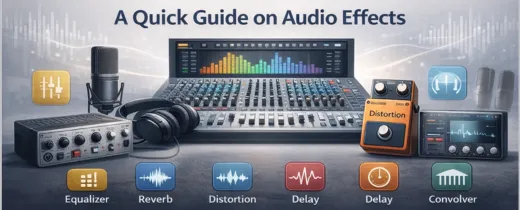
What is an audio effect?
An audio effect is a process or modification applied to a sound recording to change how it sounds. Audio effects are used to enhance, shape, or creatively transform audio by adjusting elements like tone, volume, space, or texture.
Audio effects are commonly used in music, podcasts, videos, films, and voice recordings to improve sound quality or add a specific style.
Why use audio effects?
Why do you need audio effects? There are many reasons you want or need to change a sound. Audio effects are used to improve and shape how sound is heard. They enhance audio quality, remove noise, balance volume, add depth, and create creative sound styles. Effects like reverb, EQ, and compression make audio clearer, more engaging, and professional. Audio effects help match mood, maintain consistency, and transform raw recordings into polished sound for music, podcasts, videos, and other audio content.
Top 5 Audio Effects
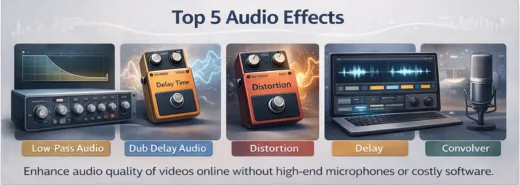
The low-pass audio effect allows low frequencies to pass through while reducing high frequencies. It creates a warm, smooth sound and is commonly used to remove harsh noise or create a muffled audio effect.
Dub delay adds repeating echoes with a rhythmic feel, often used in reggae, electronic music, and creative sound design. It gives audio a spacious and dynamic atmosphere.
Distortion alters the audio signal to add grit, edge, or intensity. This effect is popular in music production to create powerful and aggressive sounds.
The delay effect repeats audio after a short time interval, adding depth and rhythm. It can be subtle or dramatic and works well for vocals and instruments.
Convolver applies realistic reverberation by simulating real spaces. It helps make audio sound like it was recorded in a room, hall, or studio environment.